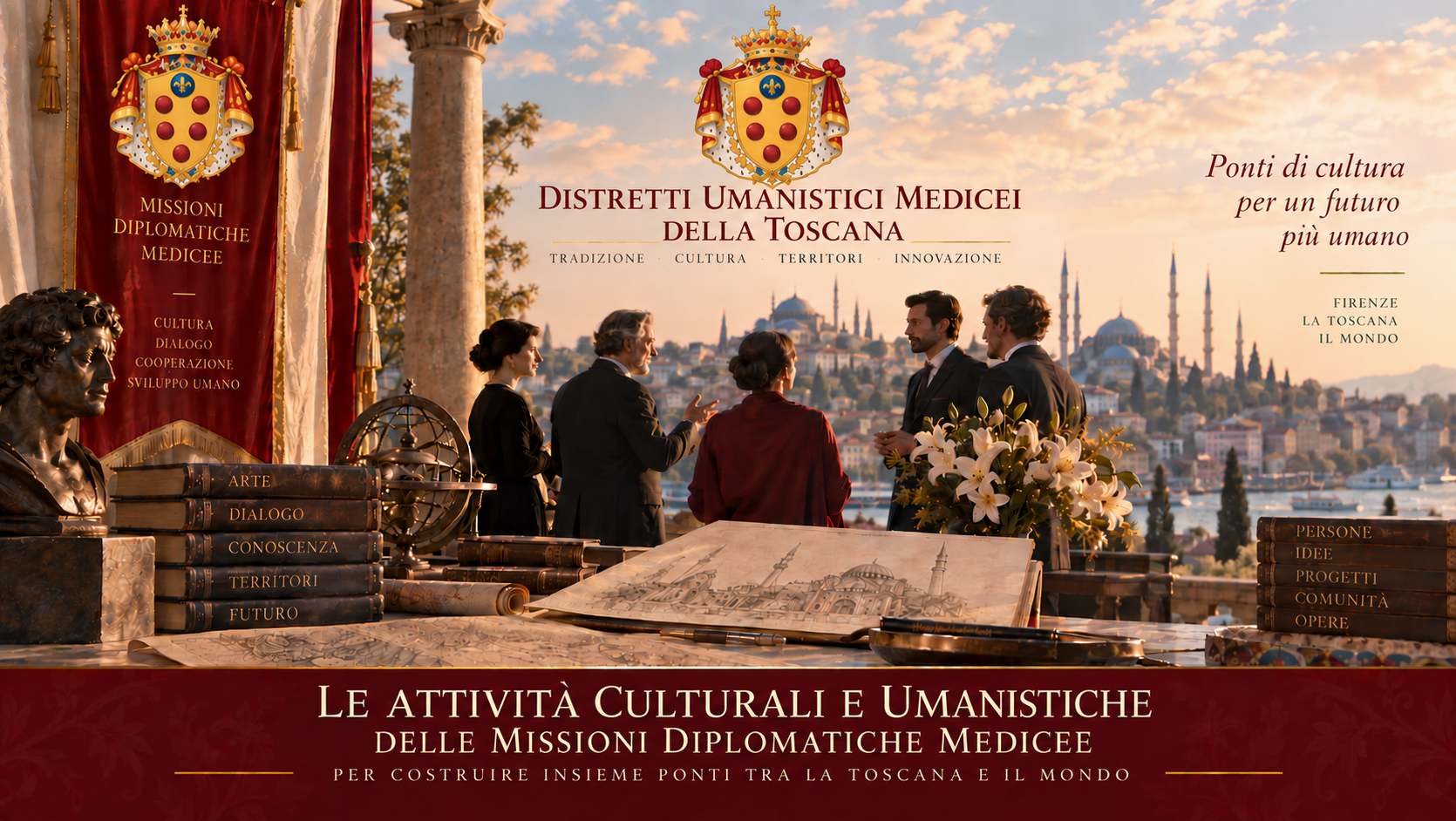
Cultural activities of the Medici Missions
Cultural and Humanistic Activities of the Medici Diplomatic Missions
A presence that represents, connects and creates
The Medici Diplomatic Missions of Tuscany in foreign countries are, within the internal organizational framework of the Grand Ducal House of Medici of Tuscany, structures of representation, relationship-building and cultural promotion. Alongside their institutional and representative activities, they are called upon to give concrete form to the principles of the Continuing Renaissance through cultural and humanistic initiatives developed in the host country and in connection with Tuscany.
This dimension is not ancillary. Together with the representation of the Grand Ducal House and dialogue with institutions, universities, foundations, enterprises and local communities, cultural and humanistic activity constitutes one of the founding reasons for the very life of the Missions. A Mission is fully alive when it does not merely attend or represent, but brings people together, generates ideas, builds lasting relationships and turns them into works, projects and opportunities for shared growth.
A Mission that goes beyond representation
Institutional representation remains an essential function: maintaining relationships, presenting the project of the Medici Humanistic Villages and Districts, fostering opportunities for dialogue with the host country, and supporting meetings, visits, cultural exchanges and relations with qualified counterparts. A Mission of the Continuing Renaissance, however, is not conceived as a merely ceremonial structure.
Its deeper vocation is to create an active community of people able to share culture, knowledge and responsibility. Ambassadors, Mission members and House of Medici Fellows can thus become promoters of initiatives that connect the Tuscan humanistic tradition with the best cultural, artistic, scientific, entrepreneurial and social energies of the country in which they operate.
From representation to a humanistic community
Over time, each Mission may develop its own Humanistic Cenacle: not necessarily a separate body, but a shared way of life through which members meet periodically, study themes of the Continuing Renaissance, invite outside personalities, develop projects and choose initiatives to carry out together.
The value of the group comes from continuity. A single event may be significant; a community that meets, reflects, commissions, supports, publishes and creates works instead generates a recognizable culture. This continuity enables the Mission to become a meeting point between Tuscany and the host country and to give contemporary substance to the Medici tradition of dialogue among the arts, knowledge, enterprise and civic life.
An identity adaptable to every country
Activities need not be identical everywhere. Each Mission may adapt them to the history, traditions, religious and civic sensibilities, universities, arts, economy and priorities of its own country. What remains common is the method: turning the institutional relationship into an opportunity for cultural growth and the human relationship into a shared project.
The Organizing Committee for Activities
To ensure that cultural and humanistic activities do not remain occasional, their organization within each Mission is entrusted to an Organizing Committee composed of five people belonging to the Mission. The Committee is the collegial operational body responsible for turning the Mission’s cultural guidelines into a concrete, orderly and continuous programme.
Composition and Presidency
The Organizing Committee consists of five members and is led by a President appointed annually. The annual term of the Presidency encourages responsibility, rotation and participation, while preserving the continuity of the programme and the institutional memory of the activities carried out.
The Organizing Committee is responsible in particular for:
- preparing and updating the annual programme of the Mission’s cultural and humanistic activities;
- collecting, reviewing and coordinating proposals from Ambassadors, Mission members and House of Medici Fellows;
- organizing meetings, cenacles, conferences, artistic commissions, publications, scholarships, awards and other approved initiatives;
- handling operational coordination with guests, artists, universities, academies, foundations, museums, enterprises and institutions involved;
- documenting completed activities, preserving their memory and encouraging continuity from one annual programme to the next.
The Committee works in coordination with the leadership of the Mission and in compliance with internal procedures, required authorizations and the specific responsibilities of the representative offices. It does not replace the functions of the Chief Ambassador or other Mission officers; rather, it is the internal collegial structure entrusted with organizing cultural and humanistic activities and ensuring their operational continuity.
The principal cultural and humanistic activities
The following initiatives form an open repertoire from which each Mission’s Organizing Committee may build its annual programme. They may be promoted directly by the Mission or carried out in collaboration with universities, academies, foundations, museums, enterprises, artists, professionals and other qualified institutions.
- Meetings on the Continuing Renaissance. Conversations and seminars devoted to the person, responsibility, beauty, knowledge and the ability to apply humanistic principles to professional, family and community life.
- Nobility and lasting family legacy. Programmes on the contemporary meaning of nobility understood as service, responsibility and transmission: what a family, entrepreneur or community wishes to leave to future generations.
- Humanistic Enterprise Laboratory. Roundtables among entrepreneurs, professionals and scholars exploring how an economic project can combine value, sustainability, culture, quality of work, heritage protection and benefit to the community.
- Tuscany–Host Country Dialogues. Conferences and meetings among scholars, artists, architects, designers, entrepreneurs and institutions from the two territories, with particular attention to the relationship between history and the contemporary world.
- Cenacles with a guest. Periodic meetings, including convivial gatherings, in which an invited personality presents a work, research, enterprise, project or testimony capable of enriching humanistic dialogue.
- Intergenerational meetings. Moments devoted to dialogue among generations, families and young people, built around the question: “What should live after us?”
- Local Humanistic Observatories. Small working groups identifying exemplary experiences in art, regeneration, craftsmanship, the environment, innovation, hospitality, culture and responsible enterprise.
- Bilingual notebooks and publications. Collections of talks, research, interviews and Mission projects designed to preserve the memory of activities and disseminate dialogue between Tuscany and the host country.
- Scholarships, awards and educational opportunities. Support for young people, artists, researchers or students through scholarships, awards, study visits, exchanges and collaborations with the Medici Academy and local institutions.
- One annual work of the Mission. The shared choice to produce each year a tangible result: a work of art, a publication, a scholarship, a restoration, a cultural project, an environmental initiative or another work consistent with the Continuing Renaissance.
Artistic commissioning: from patronage to the work
Among the most emblematic activities is the possibility for the members of a Mission to decide jointly to commission a work of art. The value of the initiative lies not only in purchasing or financing an existing work, but in reviving the role of the conscious commissioner: a community that engages with the artist, defines the meaning of the work and reflects on the message it wishes to transmit over time.
The commission may be preceded by meetings devoted to the grammar of artistic commissioning within the Continuing Renaissance: selecting the theme, identifying the artist, defining the cultural intention, balancing creative freedom and the commissioner’s responsibility, determining the destination of the work, and planning its conservation and public interpretation.
Depending on the project, the work may be intended for the headquarters or activities of the Mission, lent or donated to a cultural institution, placed in a suitable space by agreement with the competent parties, or included in an exhibition and dissemination programme. The same method may be applied to music, design, artistic craftsmanship, photography, publishing and other forms of cultural production.
The method: from the person to the work
The Mission’s activities acquire coherence when they are organized as a path rather than as a random succession of events. The Continuing Renaissance proposes beginning with the education and formation of the person, moving through awareness of value and responsibility, transforming those principles into a project and finally into a work.
This method prevents cultural activity from being reduced to mere entertainment or social display. Every initiative should be able to answer three questions: what human value does it cultivate? what relationship does it build? what trace does it leave?
The relationship with Tuscany and the Humanistic Districts
The Missions abroad act as bridges. In their respective countries they can make known the historical, artistic, environmental and productive heritage of the Medici Humanistic Villages and Districts; at the same time, they can bring to Tuscany ideas, experiences, artists, researchers, enterprises and institutions from the host countries.
This reciprocity is essential. The Continuing Renaissance does not propose a simple cultural export from Tuscany abroad, but a dialogue capable of generating positive cross-fertilization, exchanges, commissions, collaborations and projects. Tuscany offers its humanistic tradition; each country brings its own history and creativity. The Mission creates the place where these heritages can meet.
From cultural relationship to project development
A meeting with an artist may lead to a commission; a conference with a university may become joint research; an entrepreneur’s visit may develop into a regeneration project; a conversation about family heritage may lead to a scholarship or a work intended for the community. The Mission’s role is to facilitate these transitions while maintaining consistency with humanistic principles and the necessary rules of transparency and coordination.
An annual programme capable of leaving a mark
To give continuity to its cultural life, the Organizing Committee of each Mission prepares an annual programme proportionate to the size of the group and to the members’ practical possibilities. It is not necessary to multiply events: it is preferable to build a small number of recognizable initiatives and bring them to completion.
| Phase | Example | Expected outcome |
|---|---|---|
| 1. Formation | A meeting on the Continuing Renaissance | Shared language and criteria among members |
| 2. Dialogue | A Cenacle with a guest or a Tuscany–Host Country Dialogue | Opening the Mission to external expertise and relationships |
| 3. Project design | Selection of a shared initiative | Turning dialogue into a concrete project |
| 4. Realization | Artistic commission, publication, scholarship or another work | A recognizable and documentable result |
| 5. Memory | Public presentation and documentation of the activity | Continuity, reputation and the Mission’s cultural heritage |
Nature, coordination and responsibility
The Medici Diplomatic Missions described here belong to the internal organizational framework and to the cultural and associative activities of the Grand Ducal House of Medici of Tuscany and its related entities. They are not state diplomatic representations, do not exercise public authority, and do not replace embassies, consulates or other authorities of the Italian Republic, the host State or other States.
Cultural initiatives must be developed in compliance with the laws of the host country, the competences of the public and private institutions involved, the rights of artists and authors, confidentiality rules, any conflicts of interest and the internal procedures established under the Continuing Renaissance. Any economic or professional activities connected with a project remain separate from honorary dignities and appointments and must be regulated separately.
The quality of a Mission is therefore measured not only by the dignity of its representation, but by its capacity to create culture continuously, connect people of value, bring works into being and give something back to the community. It is in this passage from presence to creation that the Medici humanistic tradition can become contemporary.