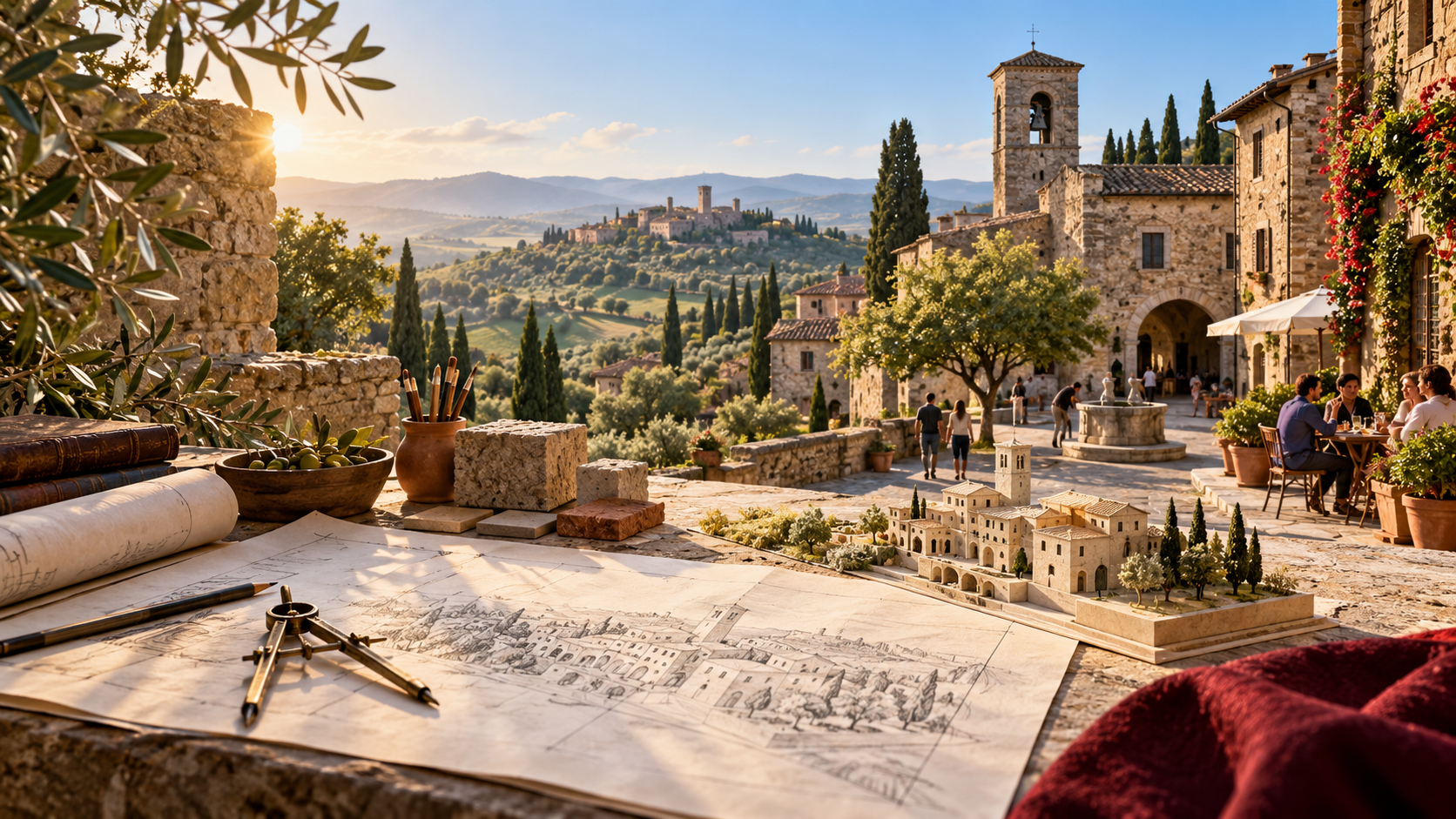
From idea to work
Grand Ducal Medicean House of Tuscany · Medicean Humanistic Villages
From idea to work
How to apply the Continuous Renaissance in practice through a framework of questions capable of transforming opportunities and visions into humanistic projects.
From theory to application
Reading the principles of the Continuous Renaissance can inspire agreement, interest and imagination. But once the value of a vision has been recognized, a question inevitably arises: how can we apply it in practice?
How can we understand whether an unused building, an economic activity, a community need, a new technology or an intuition that is still undefined can become a genuine Continuous Renaissance project?
To answer, it is not enough to fill out a form or check formal compliance with a set of requirements. We must learn to question reality, observing it from several perspectives and seeking to recognize the value it could generate.
For this purpose, the Continuous Renaissance Inquiry Frameworkhas been developed: a tool for people, businesses, professionals, Cenacles and communities that wish to translate humanistic principles into real works.
Not a test, but a method for seeing
The framework is not designed to assign an automatic positive or negative judgment, nor does it mathematically measure the “humanistic quality” of a project.
Its purpose is to help us see what may not be evident at first glance.
An opportunity can in fact be extraordinarily fertile even when it expresses one quality with particular intensity: saving a heritage asset, reviving a body of knowledge, creating work, bringing a place back to life or producing new beauty.
It is therefore not necessary for every initiative to excel in every dimension of the Method. What is necessary is to recognize where its generative strength lies and verify that its development does not produce substantial contradictions with the other fundamental principles of the Continuous Renaissance.
1. Start from reality, not from an abstract formula
Every project begins through an encounter with something that already exists: a problem, a possibility, a place, a skill, a need or a vision. The first step is to describe clearly what is before us, without deciding in advance what the solution must be.
Origin of the proposal
What problem, need or possibility have we recognized? Are we seeking a new function for an existing opportunity, or the conditions needed to realize a vision? Why does this proposal deserve attention?
These questions help distinguish a real need from a generic idea. Before designing, we must understand what drew our attention and why it is worth addressing.
Identity and memory
What history belongs to the place, activity or community? Is there something that deserves to be preserved, recovered or reinterpreted? What part of the identity we have received could come back to life?
Applying the Continuous Renaissance does not mean repeating the past, but neither does it mean acting as though nothing existed before us. Every place and every community has a history that can become living material for the project.
2. Put the person at the center
A project becomes humanistic when its value is not exhausted by the function it performs or by its economic return, but also increases people’s dignity, capabilities and possibilities.
Humanitas
In what way can the project increase people’s knowledge, dignity, capabilities or quality of life? Are people merely users, workers or consumers, or do they become part of the value generated?
The question is not only what the project does for people, but what place it recognizes for them. Can they participate, learn, develop skills and contribute to building the work?
Libertas
Does the initiative expand possibilities and autonomy? Does it produce new skills and capabilities that remain beyond the life of the project?
Freedom is not merely the absence of constraints. It is also the concrete capacity to understand, choose and act. A good project leaves behind more capable people and less dependent communities.
Responsibility
Who benefits from the work and who bears its consequences? Do promoters, investors and institutions assume a recognizable responsibility toward the place and the community?
Every work produces effects, including effects that are not immediately visible. The Method therefore asks us to identify not only the beneficiaries, but also those who may bear the social, environmental or cultural costs of the initiative.
Generosity and service
Can part of the economic, cultural, professional or relational value produced become a benefit for others? Can private success generate a shared good?
The Continuous Renaissance does not set individual success against the common good. Rather, it asks whether part of the value built by a person or a company can continue to live by producing opportunities for others as well.
3. Understand before deciding
Good intentions are not enough. A humanistic project must be supported by knowledge, competence and a concrete capacity to endure.
Universal knowledge
What do we still need to understand before deciding? Which disciplines, experiences and skills should be consulted? Are we observing the problem from sufficiently diverse perspectives?
Universal knowledge does not require one person to know everything. It requires the problem to be observed through different forms of knowledge: history, economics, art, technology, environment, law and the experience of communities.
Feasibility and sustainability
Can the project truly live over time? What resources does it require? Who invests, who uses what is created, and what economic model can sustain it without contradicting its purposes?
The economy is not foreign to humanism. It is what allows a useful work to be born and to endure. The economic model, however, must support the project’s purposes rather than overturn them.
Territory and community
What relationship does it establish with the place? Does it strengthen what is already alive in the territory, or does it risk replacing it? Does it create new relationships? Does part of the value produced remain in the community?
An investment can use a territory or contribute to its growth. The difference lies in what it leaves behind: work, skills, relationships, protection of the landscape, new activities and a greater capacity for the community to imagine its own future.
4. Receive a heritage and return it alive
The Continuous Renaissance considers heritage not as a static presence, but as something received in custody and intended to be passed on.
Heritage and continuity
Does the project merely use a heritage asset, or does it bring it back to life? Will what we receive be left in better condition to future generations?
A historic building turned into a mere commercial container can be used without being truly enhanced. Bringing it back to life means finding a function consistent with its identity and capable of ensuring its continuity.
Innovation
Does the initiative repeat an existing model or introduce a new solution? Do technology and artificial intelligence truly expand human capabilities, or do they become ends in themselves?
Innovation is humanistic when it serves people, place and work. Technology should not be introduced merely because it is available, but because it allows us to understand better, work better, use fewer resources or create possibilities that did not previously exist.
5. Do not settle for utility: seek beauty as well
One of the deepest differences between an ordinary project and a work of the Continuous Renaissance lies in the presence of beauty from the very beginning of the process.
Beauty
Can the imagined solution also be beautiful? Does it respect the beauty received? What new beauty could it introduce? Is the quality of form considered from the outset, or only at the end?
Beauty is not decoration added after all the important decisions have already been made. It concerns the form of spaces, services, objects and relationships that the project makes possible.
Art
Could artists, architects, designers, musicians or craftspeople contribute organically to the project? Can art become part of its identity rather than mere decoration?
Involving an artist does not mean assigning the task of embellishing a structure that has already been defined. It means allowing artistic sensibility to participate in the birth of the project’s identity.
Double work
Alongside the necessary work, what beautiful work can we leave? Can function and beauty coincide, or can the initiative also generate an autonomous cultural, artistic or landscape work?
An energy plant, a business, a hospitality facility or an infrastructure project responds to a necessity. The principle of the double work invites us to ask whether, alongside the necessary function, it is possible to leave a sign of beauty as well: a garden, a work of art, a restored landscape, a workshop or a space intended for the community.
6. Verify that the project generates a future
The value of a work does not coincide with what is inaugurated. It also appears in the possibilities that the work makes available over time.
Generativity
What will exist afterward that does not exist today? New skills, activities, relationships, knowledge, heritage, well-being or beauty? Does the work generate further possibilities, or is it exhausted in its own realization?
A generative project does not produce only a result: it sets other processes in motion. It forms people, creates relationships, restores confidence and makes subsequent initiatives possible.
Duration
What may remain in ten, twenty or fifty years? Does the project belong only to the present, or does it produce something that can be passed on?
Duration does not concern material solidity alone. Knowledge, a school, a professional community, a productive tradition or a new awareness of the territory can also endure.
Measure
Is the ambition proportionate to the place, resources and people? Is there a risk that the intervention will destroy precisely what it intends to enhance?
Not everything that can be enlarged necessarily needs to become larger. Measure helps us recognize the right scale of the work and prevent economic success from compromising the balance that made the initiative valuable in the first place.
Overall coherence
Can the different components coexist without one of them seriously compromising the others? Is there any substantial contradiction with dignity, responsibility, territory or beauty?
A project can produce many benefits and, at the same time, contain a serious contradiction. The final judgment must therefore consider the work as a whole.
Experience and learning
How will we understand, after implementation, what the project has actually produced? Which results can be measured and which must be observed qualitatively? What can return to the knowledge of the Cenacle?
The project does not conclude the Method: it feeds it. What is learned through experience should return to the Cenacle and become knowledge available for future works.
How to use the framework in practice
The framework can be applied through a simple procedure:
- describe the opportunity or vision in a few lines;
- address all the questions without forcing positive answers;
- distinguish facts already known from hypotheses still to be verified;
- identify the skills and people who should be consulted;
- recognize the proposal’s main generative strength;
- identify any substantial contradictions;
- establish what further study should be carried out.
For each theme, an exclusively qualitative assessment may be used:
- not relevant;
- present;
- significant;
- highly generative;
- issue requiring further study.
No final total is calculated. Even a single highly generative quality can justify further study of a project, provided that no substantial contradictions emerge with the other principles of the Method.
From observation to decision
At the end of the analysis, the Cenacle must answer three questions:
Can it become a project?
When the idea reveals a sufficiently clear function to deserve a deeper study of feasibility, participants, resources and form.
Can it become an enterprise?
When there is also the possibility of building an economic model capable of enduring without losing coherence with the principles that generated the idea.
Can it contribute to the emergence of a humanistic category?
This conclusion requires greater caution. A category should not normally arise from a single case, but from observing multiple experiences in which the same relationship among activity, responsibility, community and beauty recurs.
Taxonomy is not imposed on reality: it emerges progressively from experience.
The essential question
The entire framework can ultimately be reduced to a single question:
What genuinely generative value does this proposal contain, what could it become if we understood it more deeply, and what useful, responsible and beautiful work could it leave in the world?
This is where the theories of the Continuous Renaissance cease to be words alone. They become a way of observing, choosing and building: a method through which a possibility that is still uncertain can be transformed into a work capable of leaving something good and beautiful after us.
Foundational document
The Manifesto of the Continuous Renaissance
The Manifesto presents the philosophical and institutional vision from which the Inquiry Framework arises and shows how memory, knowledge, responsibility, enterprise and beauty can once again generate works.