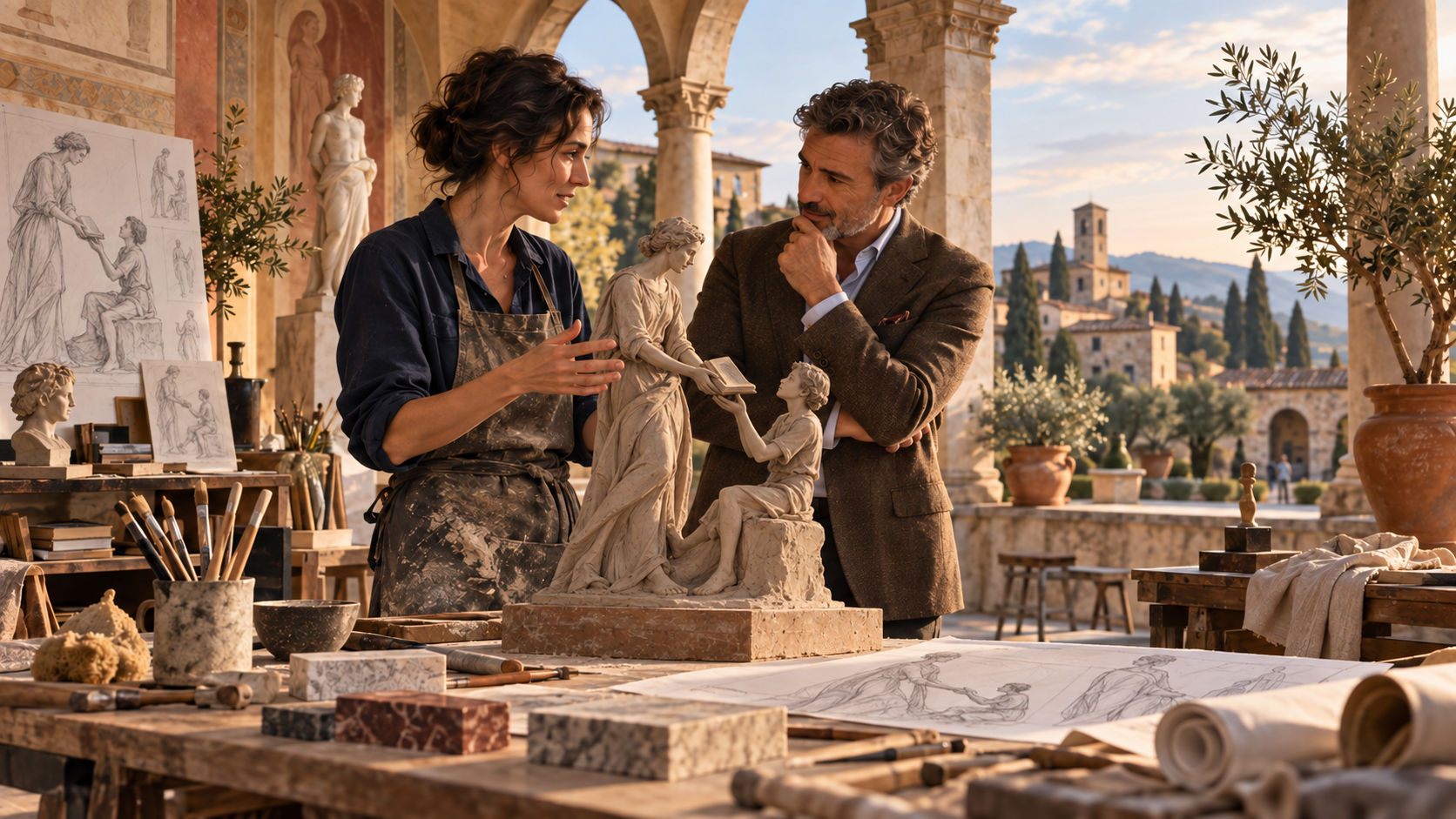
The grammar of artistic patronage
Grand Ducal Medicean House of Tuscany · Medicean Humanistic Villages
From the desire for beauty to the work of art
The grammar of artistic patronage: how patrons, businesses, communities and Cenacles can generate new art in the Medicean Humanistic Villages.
The culture of patronage
The Renaissance did not produce only great artists. It also produced an extraordinary culture of patronage.
Behind many of the works we still admire today were people and institutions capable of desiring beauty, recognizing the value of art, and entrusting artists with questions deep enough to generate works destined to endure.
The Continuous Renaissance seeks to bring this capacity back into the present.
Artistic patronage begins when a desire for beauty meets the artist’s creative freedom. Its task is not to describe in advance the work that is to be born, but to clarify why it is desired, to which place it should belong, and what value one wishes to leave behind.
The patron must therefore be precise about the meaning of the commission and prudent about artistic form: the reason for the work falls within the patron’s responsibility; the form should remain, to a large extent, entrusted to the artist.
The Grammar of Artistic Patronage translates this principle into a series of concrete questions.
1. Understanding why the work should exist
The commissioner’s first responsibility is not to choose the artist or the material, but to understand the reason for the work.
Reason for the work
Before commissioning, it is necessary to clarify why one wishes to create a work and what broader meaning it should assume.
Why do we want this work to exist?
It is not enough to answer that a space looks empty or that one wishes to celebrate an event. We must understand what presence we want to introduce into the world and what cultural, civic or spiritual need it should interpret.
Beauty
The commission must state explicitly that it aspires to produce new beauty, and not merely notoriety, decoration or communication.
What beauty would we like to add to the world through this commission?
The question compels the patron to move beyond the idea of art as a promotional accessory. The work must possess a value that is not exhausted by an advertising message or immediate utility.
2. Making the work belong to a place and a time
A work is not born in an abstract space. It enters into relationship with architecture, landscape, light, history and a community.
Place
The artist should be able to know the place before the work is defined: its history, architecture, landscape, light, functions and the human relationships that pass through it.
With what place should the work enter into dialogue?
Knowing the place does not mean forcing the artist to imitate it. It means offering a reality rich enough to elicit an authentic response.
Memory
The commissioner should identify what from the past deserves to be known by the artist, without asking the artist to reproduce it.
What memory do we entrust to the artist’s freedom?
Memory must not become nostalgic imitation. It may be reinterpreted, questioned or transformed into a new presence.
The present
The work should belong to our time and should not artificially imitate historical forms.
What in our time deserves to be expressed here?
The Continuous Renaissance does not propose reproducing Renaissance forms. It asks us to recover the Renaissance capacity to produce new forms, suited to their own time and capable of speaking to the future.
3. Engaging with human experience
The work is not intended merely to occupy a space. It should encounter people, awaken experience and contribute to the life of the community.
Humanitas
The commissioner should indicate which dimensions of human experience are particularly significant to the commission.
What human experience would we like the work to be capable of questioning or illuminating?
The work does not need to convey a single answer. It can raise questions about dignity, freedom, work, memory, our relationship with nature, or the meaning of living together.
Knowledge
The patron should make useful sources, people, history and knowledge available to the artist, while leaving the artist free to use or reinterpret them.
With what forms of knowledge might it be fruitful for the artist’s imagination to enter into dialogue?
Historians, craftspeople, scholars, residents and people who know the territory can offer valuable material. This knowledge must not become instructions, but nourishment for the imagination.
Community
It is necessary to define who will encounter the work and what relationship it may establish with those people.
For whom, beyond the commissioner, are we leaving this work?
The question opens the commission to the community and to future generations. Even when it begins from a private intention, the work can produce shared value.
4. Building a true pact of freedom with the artist
A weak commission leaves the artist without direction or seeks to control every choice. A good commission defines the question clearly and protects the freedom needed to find an answer.
Artistic freedom
Before the commission begins, it should be established what the commissioner truly requires and what should instead remain open to the artist’s research.
What are the necessary limits, and what space of freedom are we willing to entrust to the artist?
Essential constraints may concern the place, safety, duration, resources or certain functions. The subject, form and language of the work, by contrast, should not be defined in advance unless the nature of the commission requires it.
Materials and craftspeople
It is necessary to consider whether the project can involve materials, techniques, craftspeople and workshops consistent with the place and the work.
What knowledge and what hands could contribute to its realization?
In this way, the commission can generate not only a work of art, but also employment, the transmission of skills and the revival of craft knowledge.
5. Creating the conditions for the work to be born well
Beauty requires creative freedom, but also suitable concrete conditions. Time, resources and methods of collaboration must be consistent with the ambition of the commission.
Duration
The commissioner should clarify whether the work is intended to be permanent, temporary or transformable, and what relationship it should have with time.
What would we like to pass on to the generations that come after us?
Even a temporary work can leave knowledge, relationships and memory. Duration should be a conscious choice, not an accidental consequence.
Resources
The budget must be consistent with the ambition of the commission, avoiding later economic constraints that force compromises in form, materials or execution.
Do the available resources truly allow us to realize well what we are asking for?
A responsible commission does not promise what it cannot sustain. If resources are insufficient, it is preferable to change the scale of the work without compromising its quality.
Choosing the artist
One should seek the artist whose sensibility is genuinely related to the question being posed, not simply the best-known artist or the one with the highest market value.
Who might interpret this question in a form that we ourselves would not know how to imagine?
The choice should not depend only on the artist’s résumé or fame, but on the artist’s ability to engage with the deeper reason for the commission.
Dialogue with the patron
During the gestation of the work, moments of dialogue should be planned without turning them into creative control.
How can we accompany the birth of the work without taking the artist’s place?
Dialogue serves to keep alive the relationship between the work, the place and the meaning of the commission. It must not become a succession of approvals through which the commissioner ends up designing the work in the artist’s place.
6. Understanding what legacy we want to leave
Every authentic commission contains a responsibility toward the future.
Legacy
The patron should make explicit what civic, cultural or aesthetic contribution is intended to be left through the commission.
If this work remains, what will it say about us and our time?
This question is not an invitation to self-celebration. It asks the commissioner to reflect on the value that the choice may assume once the immediate circumstances have been forgotten.
How to apply the grammar of patronage in practice
Before contacting artists, whoever promotes the commission — the patron, company, institution or Cenacle — should prepare a short document containing:
- the reason why the work is desired;
- the relationship it should establish with the place;
- the memory entrusted to the artist;
- the human and community experience one wishes to explore;
- the constraints that are truly necessary;
- the space of creative freedom recognized for the artist;
- the intended duration;
- the resources actually available;
- the civic, cultural or aesthetic legacy one intends to leave.
This document should not describe the work in advance. It should formulate a question deep enough to deserve an artistic response.
Not:
“We would like a sculpture for this space.”
But, for example:
“We would like to leave in this place a contemporary work capable of entering into dialogue with its memory, expressing a value of our time, and adding a new presence of beauty for those who will inhabit it after us.”
Only after the question has been formulated should the search for the artist begin.
From commissioner to patron
The difference between a buyer and a patron does not depend only on the amount invested.
A buyer chooses an object. A patron creates the conditions for a work that did not previously exist to be born, belong to a place and become a heritage for others.
Through this grammar, the principles of the Continuous Renaissance take concrete form: memory enters into dialogue with the present, freedom meets responsibility, the economy makes the work possible, and the individual desire for beauty becomes a shared legacy.
In this way, the Medicean Humanistic Villages can once again become places where we do not merely preserve inherited beauty, but learn anew to commission works, generate new beauty and leave it to the future.
Foundational document
The Manifesto of the Continuous Renaissance
The Manifesto presents the vision from which the new culture of patronage arises: a relationship among memory, artistic freedom, responsibility, beauty and service to future generations.